
Gorilla Tribe : Silicone laces made in France and Europe
OUR ENGAMENTS
Local manufactures
At Gorilla, we are committed to keeping our production chain as short as possible. This allows us to work closely with our partners and, most importantly, maintain full control over the entire manufacturing process.
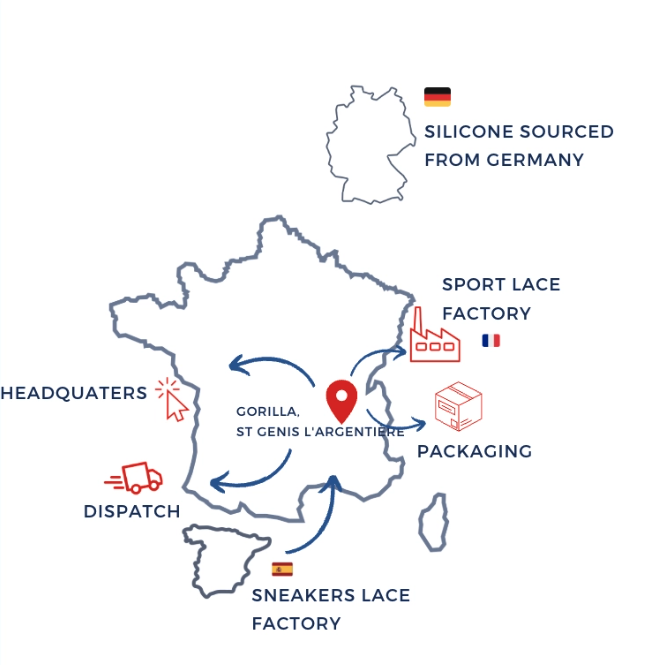
100% of our sports range is produced in France at the Le Joint Technique factory, just outside of Lyon. The local expertise shines through at Le Joint Technique, as a trusted name in the elastomer sector for over 50 years.
Their deep knowledge of silicone allowed us to develop our sports range and make the right adjustments for every use.
As a patented innovation Le Joint Technique is able to create its own unique products. They also manufacture components for a wider range of industries; automotive, industrial, aerospace, rail, as well as medical and cosmetic sectors. The company is a certified ISO 9001 and an IATF 16949.
European suppliers
At present, our urban laces are produced in Spain, as they require different production tools from our sports laces. We carefully select our partners to ensure the same quality, comfort, and durability that Gorilla stands for.
Based around Lyon, France
All of our partners are located in the Auvergne-Rhône-Alpes region (Lyon), making collaboration easy and allowing us to visit production sites whenever needed.
-
Le Joint Technique – produces our sports laces and is also where we store and ship our products.
-
Marcoux – handles the printing of our packaging.
-
Pyxis – prints our stickers and labels.
Our limits, our questions, our ambitions…
As a young startup, we are aware of our restraints, and we want to do better. But, we are constantly evolving, and we want to push the limits at the very heart of the Gorilla project.
That said, there are a few goals we are truly committed to for the years ahead:
-
Bringing urban lace production in-house, in France.
Currently, only our sports range is 100% produced in our factory using injection moulding. Urban laces require a different process; extrusion and, due to financial constraints, we are not yet able to integrate this production internally. Acquiring the necessary equipment is very challenging. -
Finding a recycling solution for our silicone laces.
Our silicone laces come in a single size to fit most shoe sizes, which means the ends often need to be cut. At present, we do not yet have a recycling solution for these cut-offs, as the quantities are too small for existing industrial solutions.
We are constantly asking ourselves: how can we reuse this material? How can we transform silicone? If you have ideas or tips, we would love to hear from you!